
Creating the Hayden's Bundle Cover
I give away a few of my secrets for creating retro book covers.
I create all of my own book cover art. Some books, like Titan's Shadow, use licensed Adobe stock photos overlaid with title text. Others, like Aero One, are completely digitally hand-drawn. A few use a mix of 3D modeling and hand-drawn art. Hayden's Bundle fits in that last category.
When I started my self-publishing journey I was at a bit of a loss for how to generate a decent cover, so I thought I'd share some of my tricks.
I already had a 3D model of Bernard's Beauty from the 43 Seconds cover, so I reused it. The ring (which is Cassini One in Erebus) was quickly created in Blender just by discombobulating a cube and radially spinning it. I didn't put much effort into materials, textures, or photorealism. The whole intent of the 3D model was to be the pose for the hand-drawn picture. Here it is modeled:
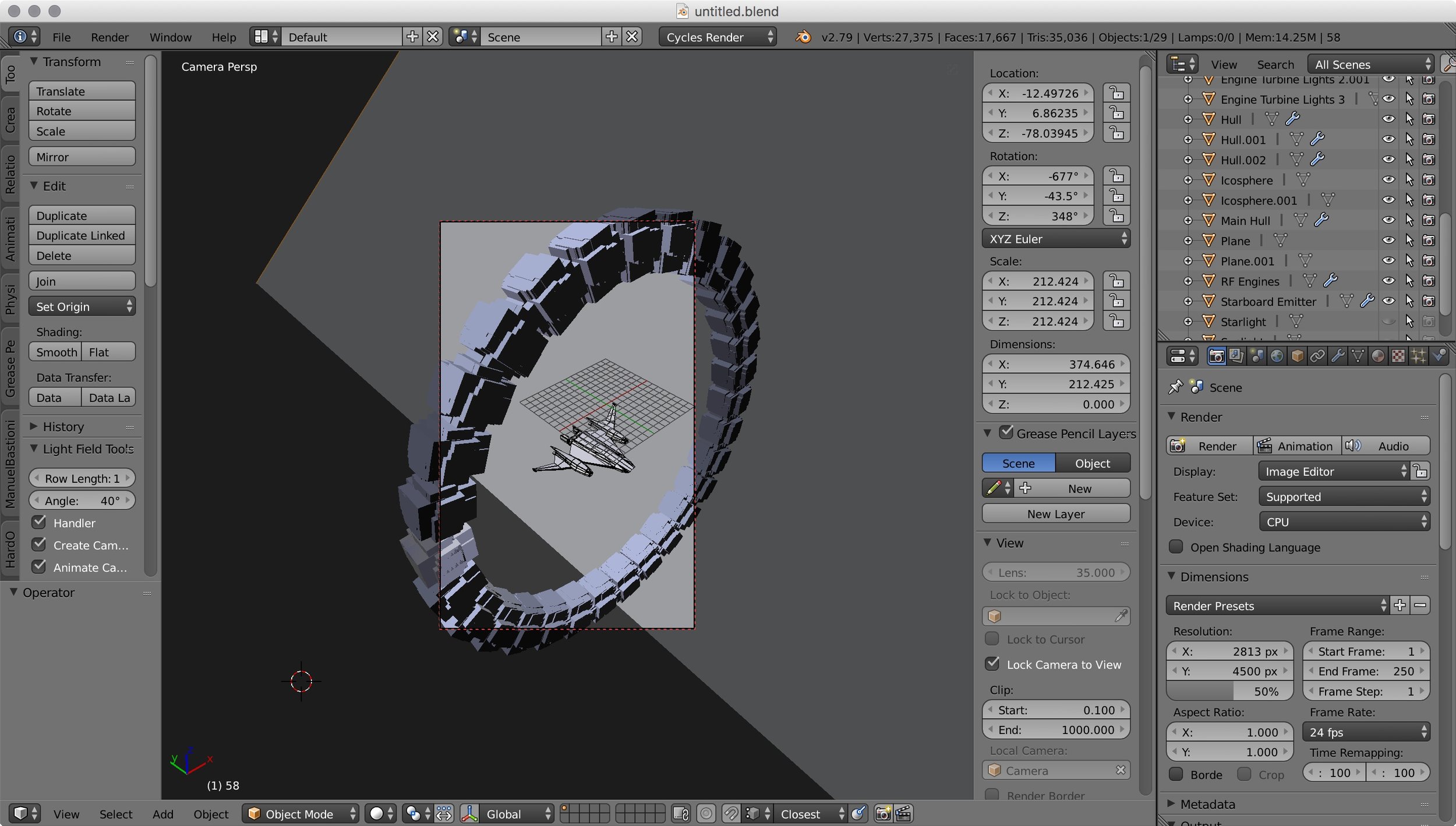
The goal was for the final art to have a retro, stylized look. Because of this, I wanted to have a limited color palette. The next step was to import the render into Photoshop and run it through a posterization filter, reducing the color levels. I tinkered with the color balance at this point, shifting it green:
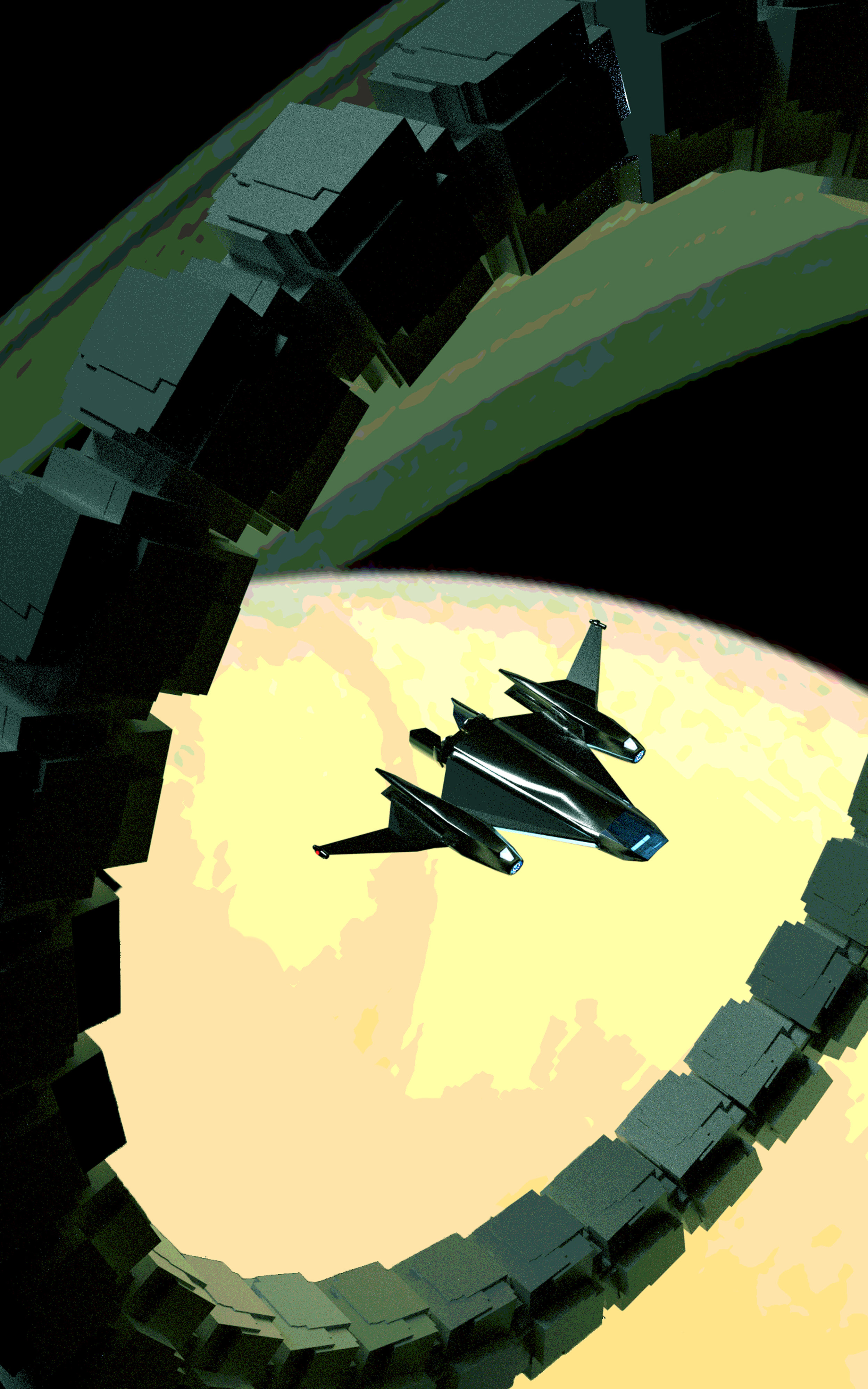
Now comes the hard part. I masked every detail of the plate and repainted it by hand. Before I started, I worked out the color palette, choosing seven main colors for the picture. I constrained myself to only create new colors by mixing the main colors. This helped give the picture color harmony:

Main colors at top. I started mixing intermediates beneath them.

Masking the plate and hand-painting over it. Aside from assigning new colors, this let me simplify many of the complex shapes and gradients.
This was very labor-intensive. Some details, such as the starry background, needed to be created from scratch using Photoshop brushes. Once it was finished, I used Photoshop's color balance feature to adjust the overall color-scheme, then I moved on to the text. I have some standard fonts and effects I use in the Hayden's World series, so most of the text settings are reapplications from previous covers. The real trick here is working the layout so the text works with the art:
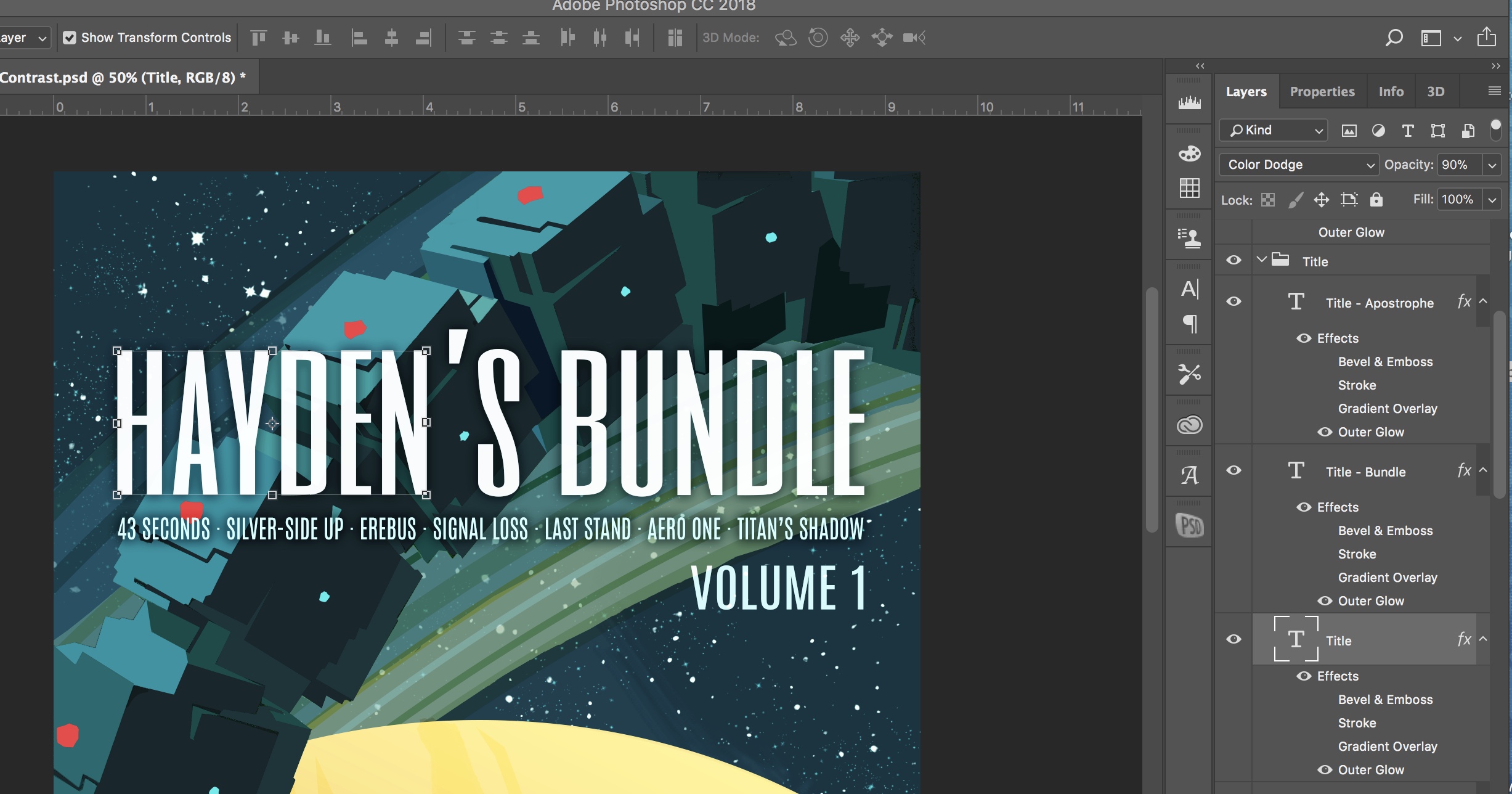
Text layers at right. Outer glow is enabled for the letters, but is set to a dark color, creating a shadow to enhance legibility.
That's it! I save the image in the correct dimensions for Kindle, and I'm good to go.

The last thing I do is make some quick social medial blocks, just by cropping. Here's the title block I use from Twitter promos:

Hope this was helpful. Enjoy!

Hayden's Bundle Now Available
Get all of the Hayden’s World stories in one bundle and save 25%.
Get all of the Hayden's World stories in one bundle and save 25% with Hayden's Bundle: Volume 1. The book includes: 43 Seconds, Silver-Side Up, Erebus, Signal Loss, Last Stand, Aero One, and Titan's Shadow.


Three for Free
Get the first three Hayden's World stories for FREE April 2 - April 6. http://bit.ly/haydensworld
Get the first three Hayden's World stories for FREE this week (April 2 - April 6, 2018) on Kindle: http://bit.ly/haydensworld


A Case for Cases - Update
After a month of use, I give an update on my iPhone X case results.
Last month I bought an iPhone X. I have no regrets - it's an awesome phone. But, it is a glass bar of soap, and this necessitates a case.
As an engineer, I have a knack of overthinking things. This was the case with my case. I wanted the saddle brown leather case, but rationalized myself into the silicone case. In the end, however, heart triumphed over mind and I chose the leather.
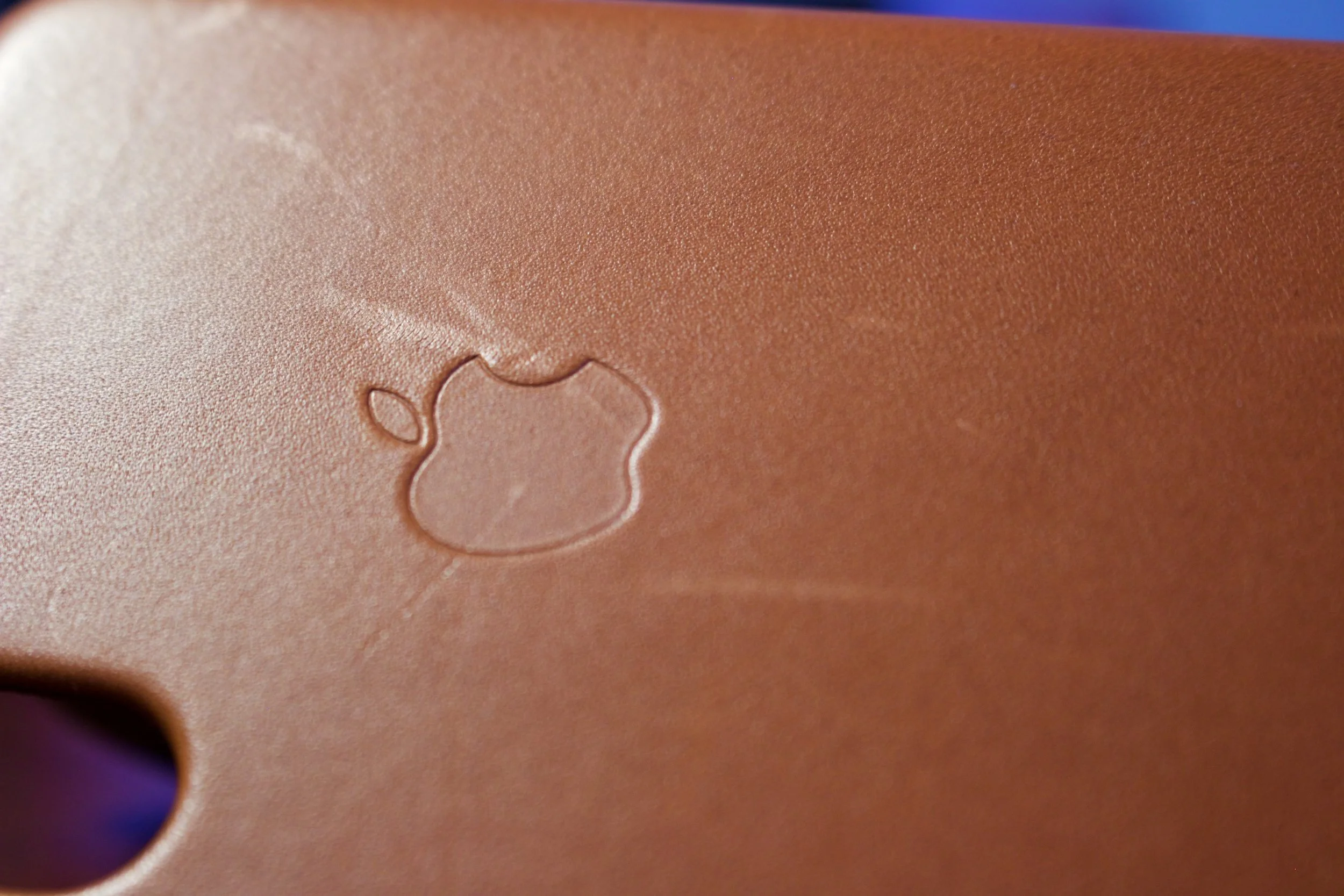
One month later, I've dropped my phone a few times. Never on concrete, but a few times on the hard floor at work. It's unscathed. The leather case itself was initially a scuff magnet. The slightest brush with a fingernail or jean rivet left scratches. But, it self-heals. The more I handled it the more the oils from my skin darkened and smoothed it, and scratches disappeared.
Initially the case was quite rigid and slick. After two weeks it become grippier and soft. I think the amount of grip is just right, now. It's developed a patina, darkening around the edges, and it looks great, like a worn saddle. Originally it was a uniform caramel color, but I prefer the darker brown.
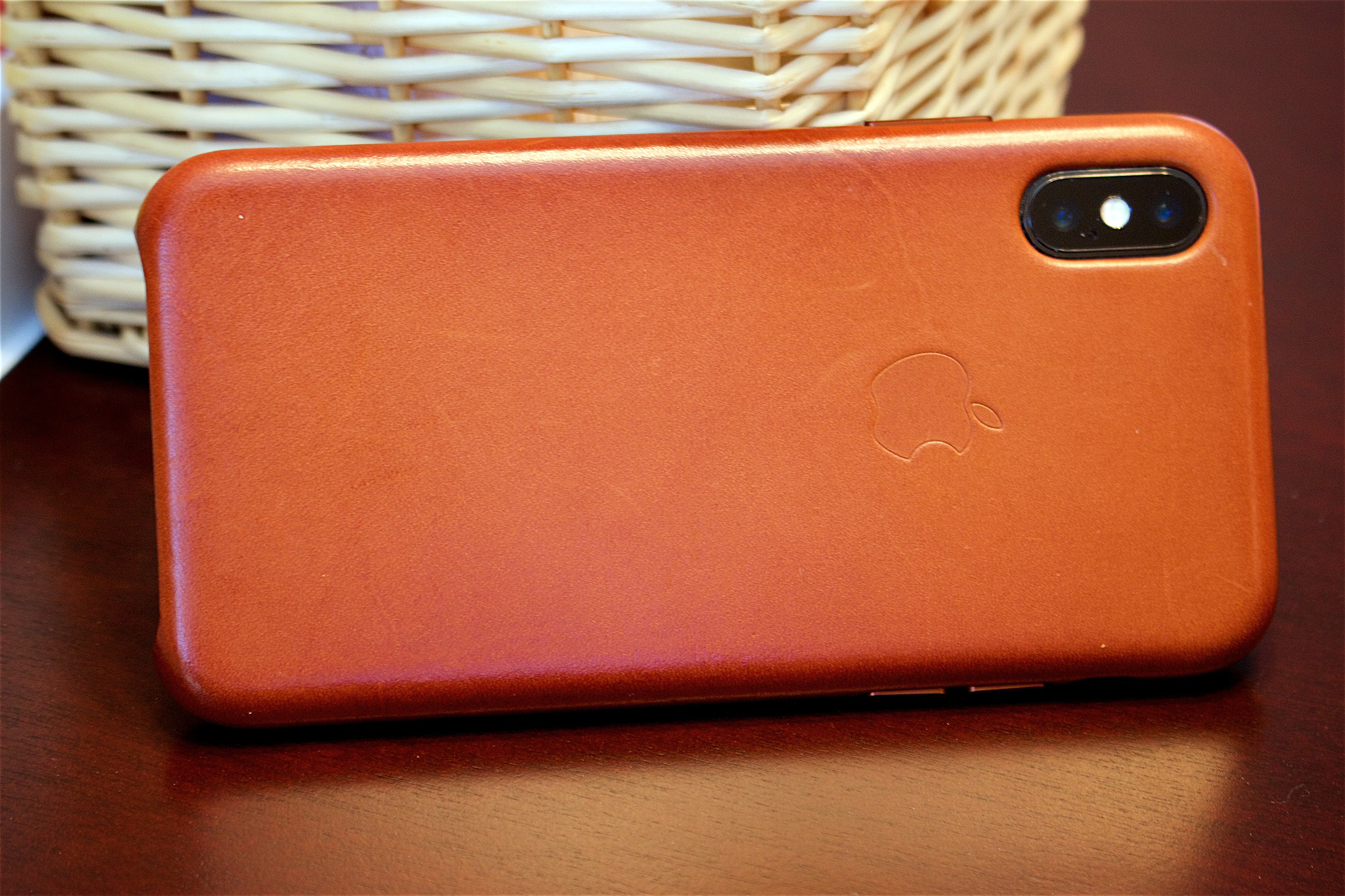
Here's a few pics. If you return to my original post, you can compare them versus new:


Titan's Shadow - Story Extras
A few behind-the-scenes peeks at the writing of Titan's Shadow.
SPOILER ALERT: If you haven't read Titan's Shadow, grab a copy (it's FREE this week!). The rest of this article gives away some major plots points, otherwise.
A few sciencey bits first:
- Jia only wears arctic gear and a full-face breather in Saturn's clouds. Atmospheric pressure is eighty-percent Earth's and the temperature, -99 C, isn't that much colder than the coldest temperature recorded on Earth, -89 C, in Antartica.
- When Jia and Ping attend the eclipse party, Enceladus eclipses the Sun. Janus, Mimas, Enceladus, Tethys, Rhea, Dione and Titan are all capable of causing eclipses on Saturn.
- Despite its thick nitrogen atmosphere, Titan is extremely cold at -179 C, which is why Jia's cryowear is adequate for Saturn but not Titan. If you're wondering why Ping needs a PLEX suit here instead of a regular spacesuit, read the Science of the Story section of Aero One (TLDR: spacesuits are not designed to keep you warm).
- Titan's atmospheric pressure is higher than Earth's. Jia doesn't depressurize Lucky Cricket's airlock before going outside. When she opens the door, Titan's atmosphere blasts in.
- Iapetus is remarkably far from Saturn. At 3,560,851 km, you could fit 279 Earths between Saturn and Iapetus. It's a good place for a smuggler's base.
- The concept of celestial Julian dates is only somewhat fictional. Real Julian dates are popular for astronomy because they are not calendar dependent; instead, they use Jan 1, 4713 BC, as '0' and count up days elapsed. In everyday-life you probably encounter a simplified version of a Julian date which counts days elapsed since Jan 1st of the current year, maxing out at 365. There's no reason that you can't do the same thing for any other planet. For example, Venus has a 225 day year, so it could have its own simplified Julian calendar which spans from zero to 225.
- Although the constellations will appear the same from any planet in our solar system, the morning stars (which are planets) will change. In Park 270 at the end, Jia and Ping see two morning stars - Earth and Venus - low in the horizon.
A few writing bits:
Titan's Shadow has a linear structure, but, like an action movie, has a few big action scenes. If you break the story into normal scenes (S) and action scenes (A) for the nine chapters, it looks like:
S S A S S A A S S
Neat, huh? It's fairly symmetric.
In terms of writing lingo, the inciting incident occurs when Jia spots Flynn, the midpoint is the news of the Hephaestus attack, the climax is the shoot-out with Sulo, and the Hermes's return is the resolution. If you map them out as inciting (I), midpoint (m), climax (c), and resolution (r):
- I - - M - C - R
It works out how you'd expect. The midpoint is exactly in the middle (and is the turning point for the story).
Aero One's story structure was very different. In terms of normal scenes/action scenes, its five chapters map as:
A S S/A S A
Still symmetric, but the opposite of Titan's Shadow. Aero One starts with action and lets you get caught up in the middle.
Okay, a bit technical for writing tidbits, but thought I'd mix it up and give you both the science of the story and also the science of the story. Hope you enjoyed it.

Titan's Shadow - FREE this week
Get Titan's Shadow for FREE this week: http://bit.ly/titansshadow
Get Titan's Shadow for FREE today (March 19) through Friday (March 23): http://bit.ly/titansshadow


Titan's Shadow - Deleted Scenes
I share a few deleted scenes from Titan's Shadow, and why they were cut.
In the Hitchhiker's Guide to the Galaxy, there's an editing joke about how Ford spent the past decade writing about all of Earth's best places, restaurants, and experiences. When his work is submitted for publication, the entire entry for Earth is simply edited down to two words: mostly harmless.

In a 12,000 word story, I tend to edit out 2,000 words. Mostly I delete redundant words and phrases. For example, he set the book down on the table becomes he set the book on the table. Sometimes I cut out entire sentences if they're dragging down the rhythm of a paragraph. Occasionally I'll scrap a scene if it doesn't do anything to move the plot forward. Sometimes it's a bit painful. It reminds me of playing Magic: the Gathering back in the 90s and trying to build a sixty-card deck. Choosing those last few cards to get to sixty was always agonizing because I felt that I needed each one.
There's no sixty-card rule for short stories, but there is pacing. Readers expect to hit certain waypoints at specific times, and the story will feel off if they're missed.
Here's a few of the deleted scenes from Titan's Shadow, and why they were cut:
SPOILER ALERT: If you haven't read Titan's Shadow, grab a copy for 99 cents before proceeding.
Original Chapter One (preceding Cassini): Shanghai
Jia sits in the pristine hallway with her palms folded over her knees. Butterflies dance in her stomach. In the corner of her eye she watches a young administrative assistant swiping icons between translucent displays, the Shanghai skyline spiraling behind her. On the adjoining wall rests the China National Mining Association logo. The assistant becomes aware of Jia’s gaze and stares back. Jia curls her fingers into fists.
A mahogany door creaks open and Ping emerges wearing a dark suit and tie. They lock eyes a moment. Over his shoulder lies an interview room and a single chair. Before she can ask him how it went Ping says, “They’re ready for you.”
She stands and smooths her skirt, her footfalls clacking along the marble. When she reaches the doorway Ping steps aside, but as she is about to pass he places his hand on her arm. A touch of his hand and a smile, then she’s through the threshold. The mahogany door closes behind her.
Two men and one woman sit at a table opposite an empty chair. The lead motions towards the chair. “Please, Miss Xu.”
Jia crosses the room and sits. Chao is the senior and continues to speak, “Thank you for your candor during this week’s interviews.”
Jia breathes in and out, aware of the rise and fall of her chest.
Chao nods to Lei and he speaks next. “Miss Xu, regarding the matter of initial contact with the pirate vessel Maya at the Uranus T2 orbital platform, you are found negligent of following proper disengagement protocols where crew safety or corporate property are at risk. Your actions resulted in the significant injury of Senior Flight Engineer Ping Sun and the complete destruction of the Cormorant-class light carrier Prosperity.”
A flush spreads across her face to her neck.
“Furthermore,” Lei adds, “during the same encounter you brought the ascent vehicle to full power while the platform’s umbilical and clamps were still engaged.”
“I was being shot at,” Jia says, the words more curt than she intended.
Lei sighs. “And then you intentionally destroyed it at a loss of a seven-hundred-and-fifty-million yuan.”
“Respectfully, Chief Lei,” she begins, “it was worth a tenth of what’s on the platform, and I didn’t think the pirates would be able to access the platform without it.”
Lei interlaces his fingers. “But they did, Miss Xu.”
Jia looks away, glancing at nothing. Her expression sours.
“Had you disengaged it is likely both ships would have survived.”
She shakes her head. “You don’t know that. The Maya was clearly aware of us before we saw it. They could have fired on us as soon as we tried to disengage.”
“We’re interested only in facts.”
“Well, Chief Lei, here’s a fact for you. One hundred and twenty-eight seconds. That’s how long it was from initial contact to the battery room exploding. I spent that time dodging slugs, remote-piloting the ascent vehicle, piloting the Prosperity, and generally trying to keep me and Ping alive. I’d like to see what you could do in that situation.” She shakes her head. “The real person responsible for all of that is still out there, and no one’s doing anything about it.”
Lei is silent for a moment. He taps at the screen on the table, then glances back to Jia. “Next, regarding the matter of the one hundred and sixty-three thousand liters of Helium-3 you purged to atmosphere—“
She laughs. “Here we go…”
“—your actions are deemed appropriate by the panel.”
Jia raises her eyebrows. Her lips part, but she says nothing.
Lei continues. “The loss of six-point-eight billion yuan of Helium-3 is regrettable, but purging was appropriate to ensure crew safety. In this case.”
A cautious nod from Jia.
“Your testimony was fully corroborated with Senior Flight Engineer Ping Sun. We find him non-culpable in these matters.”
“As you should. Ping didn’t do anything wrong.” She curls her hands into fists again. “It was my command.”
“We agree.” Lei looks over to Meilin.
“Then you’ve reached your decision,” Jia says.
Meilin says, “We have. Your CNMA contract is terminated, effective immediately.”
Jia shakes her head. “That’s not fair.”
“To be clear, we had an extended discussion about pursuing legal reparations, recommending a pilot’s license suspension—”
Her face burns. “You can’t do that.”
“—but we will not do so, contingent on you not challenging the separation package. Your license will be intact and you can pursue other work.”
“Sure, I’ll just be blacklisted with every carrier.” She looks back to Lei. “You said Ping’s not responsible, right? I want your word that he gets to stay before I agree to anything.”
Lei frowns slightly. “We have not asked Mr. Sun to leave.”
Jia exhales audibly through her nose. “Fine.”
Meilin stands, and the rest of the panel joins her. “My assistant will escort you to your workspace, where you’ll need to clear your belongings.”
Clear your belongings is a gut punch and Jia’s knees are weak as she stands. She turns, crosses the room, and pulls the handle to the heavy door. Ping stands from the bench. In the corner of her eye the assistant in the red blouse moves outside her desk and walk briskly towards her, footsteps echoing rhythmically.
“I’m sorry,” Ping says.
“Miss Xu,” the assistant says, closing.
A lump forms in Jia’s throat as she wraps her arms around Ping’s strong shoulders. She speaks softly in Ping’s ear, “It’s okay, I knew this is how it would be. But Lei gave me his word, you’ll be fine.”
Ping leans back, slides his hands to the tops of her shoulders, and looks her in the eyes.
The assistant arrives. “It’s time to go. I’ll escort you both to your desks.”
Jia’s brow furrows and she ignores the assistant. I’ll escort you both. She questions Ping with a gaze.
Ping rubs her arms. “When they told me they were going to fire you—”
She shakes her head. “No, Ping…”
“—I quit.” He smiles. “Hey, we’re a team. You wouldn’t want me inflicting my bad jokes on another pilot, would you?” He smiles slightly and slides his hand down to hers, intertwining their fingers. “Wherever you go, I’ll be there.”
Jia squeezes the tears from her eyes, leans her head on his shoulder, and just breathes.
WHY IT WAS CUT: The final version of Titan's Shadow doesn't introduce the inciting incident (Jia spotting Flynn during the eclipse party) until midway through the second chapter. This is already a bit late. Pushing it out another chapter by starting with Shanghai caused pacing problems. Ultimately, what happens in Shanghai is a retelling of Aero One which can be summarized as Jia gets fired for her actions in Aero One. It's covered in her dialogue with Galen after she turns in Flynn.
SCENE BETWEEN "IN THE BLIND" AND "PISTACHE"
(DESCRIBING JIA AND PING'S RESCUE FROM TITAN)
Punga Mare station is illuminated like a roadside store on a stretch of desert highway. In the distance, a great black lake spans away from the shore’s edge mirroring the perimeter lights. The station is deserted and feels like an arctic research base. Jia and Ping stand near the main runway. She has her suit heater on, chewing up battery but warding off the chill.
In the sky, a pale patch of light moves beyond the clouds, growing brighter. When the ship emerges, its spotlights carve foggy cones in the night. The craft turns in a wide arc and skims over the lake. It’s large, armored, and both wings sport railguns. Engines hum, crackling the air. It glides to a halt on the runway twenty meters ahead. When the door opens, five men in U.N. PLEX suits emerge, rushing over to meet Jia and Ping, and they’re aboard the ship in an instant.
The gunship blasts back up through the atmosphere like a rocket. Clouds part as a sheath of ethane rain pelts the window, the raindrops looking like a blizzard in the ship’s forward lights, then the storm gives way as darkness surrenders to stars. One of the stars is its own constellation of red, green, and white lights. As they draw nearer, Jia can see structure—decks stacked on each other extending along a trapezoidal axis, docking bays spaced like legs on a centipede, and weapons everywhere. It’s at least three hundred meters long with an asymmetric forward nose. Massive letters read Hermes. It grows impossibly large as their gunship flies along its structure into one of the caterpillar-leg docking bays.
A soldier calls over from the airlock. “You both zero-gee capable or you need an escort?”
“Yeah, we’re good,” Ping says.
When they arrive at sick bay, it’s world-class, pristine white, and has tech Jia hasn’t even seen on Earth. Their doctor programs a nano-cellular repair regimen for her burns, encapsulate the bots under a layer of synthetic skin, and sets them to work. Her palms and knee feel like they’ve been dipped in glue. It could be worse. In a week it’ll peel off and she’ll have new skin.
Their debrief is short with warrant officer Casey Gray from the Criminal Investigations Unit. Whoever deployed the drones did so on the dark side of Titan, out of view. Casey’s reviewing all traffic to Titan during the past few days, but Jia doesn’t need him to tell her that their job was a setup.
“So,” Casey says, buckled into a chair in the interview room. “That was some pretty fancy flying. A couple of our guys can’t believe you kept three raptors at bay in a class-four hauler. Your PLAAF days are showing.”
Jia shrugs. “It’s been a while.”
“You flew TG-32’s. Two combat ribbons. Why’d you leave?”
“Family obligations.” She shifts. “Anyway, it got me my pilot’s license and paid for my degree.”
He nods and looks at Ping. “Quick thinking with the navcon telemetry.”
Ping shakes his head. “No special training. I’m just a nerd.”
Jia curls her fists. “You still have Flynn on board?”
A nod. “We do.”
“Either he somehow passed word about us or his friends figured it out. Either way, pretty sure he’s the reason we’re here. I’d like to have a few words with him.”
Casey appraises her. “I’d advise against that.”
“I don’t—”
“Request denied.” He unclicks his harness and pushes up from his seat. “Why don’t you both get some dinner and rest? Your escort will take you to the galley. We’ll reconnect tomorrow.”
“We’re not going back to Cassini?” Jia asks.
“Need to secure the area first,” Casey says, folding up his slate and tucking it into his belt. The door opens behind him.
Afterwards, Jia holds a tether beside the bed in their quarters. Ping rubs her back while she rubs her neck. Her hands no longer hurt, but they feel odd, like they’ve fallen asleep and she can’t shake feeling back into them. She takes a deep breath. “I don’t know what we’re going to do.”
WHY IT WAS CUT: The scene can be summarized as the Hermes rescues Jia and Ping and returns them to Cassini. Introducing Casey as a second investigator created one too many detectives. Instead, I moved the backstory dialogue about Jia's PLAAF days to Galen's conversation, referenced that she'd been treated by the Hermes medics, and expanded the investigation dialogue into the Pistache and Yin and Yang chapters.

Titan's Shadow (First Chapter, 1200 words)
Saturn’s ammonia clouds stretch into an infinite horizon, the Sun casting long shadows across the platform’s deck. Lucky Cricket rests silhouetted against the sky while shimmering aerostat lights hang suspended in the distance, waiting.
ONE
CASSINI
Saturn’s ammonia clouds stretch into an infinite horizon, the Sun casting long shadows across the platform’s deck. Lucky Cricket rests silhouetted against the sky while shimmering aerostat lights hang suspended in the distance, waiting.
A dull chill seeps into Jia’s arm as she fishes through the toolbox. With her cryowear, she resembles an arctic explorer with a full-face respirator. She finds the logic probe and hands it to Ping.
Ping kneels beside the aerostat. An aura of menace surrounds it, like working underneath a boat in dry dock. Another gust of wind rattles the blimp’s umbilical. Alloy support cables twang like guy wires and the aerostat groans as it shifts in the dock clamps. Ping stumbles and catches the rail, pushing his hood back. He’s tethered, same as her, but it’s still unnerving. It’s a long way down through Saturn’s clouds.
He slips the logic probe into the access panel. “Did you know that the Assyrians named Saturn ‘Oldest of the Old’?”
Jia smiles. She loves Ping’s trivia. “Well, did you know that it’s the least dense of all the planets? If you had a really big ocean, Saturn would float.”
Ping holds up his hands. “You been raiding my trivia files?”
Jia winks.
He examines the probe. “There you are. Open panel forty-two cee.”
A square inset on the aerostat’s surface slides away. Scorch marks mar the control board. She opens the spares compartment and locates a replacement. “I have no idea how Voj makes his numbers with these old J-series stats.”
As if she summoned him, Voj appears in a comms window. “Status?”
“I think we’ve got it,” Jia says. She hands the spare to Ping. “Spectrometry module is fried.”
Voj frowns. “You going to wrap up before sundown? You need to stay on deck overnight, it’s coming out of your commission.”
“Yeah, we’ll make it.”
“Why you wearing cryowear, anyway? You freeze to death on my deck, you’re going to screw my safety numbers.”
“Don’t worry, Voj, your ancient aerostat isn’t worth dying over.” She lifts up the spectrometry module. “Seen this before, you know. You guys should check your clean room procedures. Someone touching parts with ungloved hands cost you fifty thousand.”
“Just fix it,” Voj says. The comms channel closes.
Jia smirks.
“Eh,” says Ping, “become a freelancer, meet exciting people, make new friends.”
Jia touches Ping’s elbow and he stops. “Sooner or later we’ll have enough saved so we don’t have to take these throwaway jobs.”
Ping gazes up. Saturn’s rings are banded specters against an ultramarine sky. “I’ll miss the view, though.”
* * *
Cassini Station is a city in space, habitation decks rotating against the backdrop of Saturn’s F ring. Every day the station grows as construction vehicles ferry in components. It’s like living in a city where new streets and buildings appear each week, a frontier world powered by its own gold rush of Saturn’s sixty-two moons.
From Jia’s approach vector the station’s rings appear stacked and squashed. The comms icon illuminates. “Lucky Cricket, you are cleared for landing at dock four.”
Jia glances at Ping and smiles.
“Oh,” Ping says, “this is my cue.” He taps the screen and accepts the tower instructions. A heads-up flight path overlays the forward view. “Cassini Control, NG-991 Lucky Cricket, acknowledged.”
“You’re sounding like a pilot,” Jia says. She taps the controls and the ship rolls to match the next waypoint.
“Eh, next we should start training you to be an engineer.”
Jia scrunches her nose. “Yeah, math’s not really my thing.”
Ping holds up both his palms. “You gotta be kidding, right?” He motions at the choreographed dance of space traffic. “If there were any more math around here you’d be tripping over it.” He extends the struts.
Jia coasts into dock four and sets Lucky Cricket down.
It takes a moment to adjust to the station’s spin and she staggers to her ship’s locker. Inside rests a brown jacket with silver stripes, red gradated sunglasses, and a pulse pistol. Ping gives her a sidelong glance. He disapproves of the gun, but she won’t get caught flat-footed again. She dons the jacket and glasses, leaves the gun.
They descend the umbilical and catch the elevator to Customs. The main transit hub is a bustle of people with systems engineers, construction specialists, haulers and gas miners. Beyond it lays the Exchange, a dedicated market hub full of shops and services looking a bit like the malls lining Earth’s airports. It’s an assault on the senses with prismatic holo ads and thumping music everywhere.
They slow as they pass the exosuit shop, eyeing the metallic amber PLEX suit. Another job, maybe two, and they’ll have enough saved. With it, they can go places cryowear can’t. They can unlock a tier of jobs which pay real money. With enough real money, they can move back to Earth and take back the life they lost, and she can finally lift her family out of the slums where she grew up. But, for now, they take the lift to their apartment.
Ping heads to the kitchen. “You want some breakfast?”
They’ve been up all night flying back from Saturn and Jia’s not sure if she’s exhausted or hungry. At the sound of him rustling through the pantry her stomach rumbles. “Sure. Would you make me a tea?” She rubs the back of her neck. “I’m going to catch a quick shower, okay?”
“It’ll be ready when you get out.”
She enters the bathroom and leans on the sink, looking in the mirror. Above her left eyebrow is a small v-shaped scar. For a moment, she thinks about the bathroom mirror in the emergency area of the Uranus mining platform, about her ship shredding around her, and the expression which peers back wants to be somewhere else. Somewhere with Ping, for certain, but it’s like she’s on a business trip which never ends, staying in a hotel which is not her home. Everything that was her life burned up in Uranus’s cerulean sky.
After a moment she strips off her clothes and steps in the shower. The hot water is wonderful on her skin. She rubs her neck and the heat relaxes her muscles. For a minute, only the white noise of raining water and steam fill the small space. She closes her eyes.
The shower door slides open and Ping’s hand touches her shoulder. She turns and faces him. They kiss. There’s barely enough room for the two of them, but it’s not the first time they’ve shared the space. They embrace a moment before Ping rubs her shoulders, and she turns as he massages her neck. It’s a very long day, but the heat of Ping’s hands on her shoulders melts it away.
“The tea can wait,” he says. “Thought you’d like company.”
Not everything was lost, she realizes.
She sighs. “Yeah.”
* * * *

New Release - Titan's Shadow
Titan's Shadow is now available on Amazon for 99 cents.
Jia, Ping, and the pirates are back in the sequel to Aero One. Get the 12,500 word novella, Titan's Shadow, for 99 cents on Amazon.


New Story Teasers
Jia, Ping, and the pirates return. Read some teasers from my soon-to-be released novella, Titan's Shadow,
Jia, Ping, and the pirates return in my new story, Titan's Shadow. I'm working on editing and revisions now and will release it this month. Here's a few teasers:
Saturn’s ammonia clouds stretch off into an infinite horizon, the Sun casting long shadows across the platform’s deck. Lucky Cricket rests on the transit ramp silhouetted against the sky. Shimmering aerostat lights hang suspended in the clouds, waiting.
At first it’s a nibble out of the Sun, growing from its left side. It’s not until nearly half of the Sun is blotted out that the glare dims and the party fades to sunset. The kaleidoscopic sea of neon wearables pulses and shimmers with the revelers. Ping’s hair shifts to amber. He slides his hand behind the nape of Jia’s neck and draws her near. Enceladus centers itself perfectly over the Sun, ringed by the corona, and, for a perfect moment, it’s night inside the Panorama. Ping kisses her, his lips warm and tasting of champagne. As they pull apart, the Sun fades in and the party returns to daytime.
Jia’s grunting, fighting with the controls. Fire suppression sprays a white fog which wreathes around the windows.
Ping is groggy, shaking his head. “Are we going to crash?”
Jia glances at the aft camera. The port engine sheathing peels away and spins off into the darkness. “Yes. We are definitely going to crash.”
Galen stands and heads to the airlock. Inside, his EV suit is colored cobalt metallic blue with copper plates. Beside the suit is a rifle and pistol. He checks both before gearing up.
Jia slips into her red EV suit as Ping dons his PLEX suit. Once she’s dressed she checks her pulse pistol. The ammo indicator is full. She slides it into her hip mount.
“Ready?” Galen asks, slinging his rifle onto his back.
Jia’s nervous, shifting her weight. “Yeah.”
Overhead, Saturn is a yellow moon in a speckled sky. A lone white star traverses silently across that sky. It flashes blue and Galen’s ship blossoms into a fireball. Chunks rain down streaming fiery tails, impacting the deck, while the smaller pieces shoot up into the sky like a thousand fireflies. There’s no blast wave in the vacuum, just the low rumble of the explosion’s sound transmitting through their boots. Everyone staggers back into the doorway.
Galen is stunned. He grabs onto the door frame and steadies himself. Ship pieces pulse orange like dying embers, flashing as if gunpowder were sprinkled on them.

A Case for Cases
Well, I should probably put a case on my $1000 glass wet bar of soap.
Yes, I bought a thousand dollar animoji machine. It's sleek, it's beautiful. It's made of glass. It's a wet bar of soap. That's the only way to describe holding an iPhone X. The first day I had it I didn't have a case. Every time I took it gingerly out of my pocket I looked like Jeremy Renner in the Hurt Locker handling live ordinance.
Granted, my past few iPhones have had a case. My 4S had a leather case which looked like old sneakers after a few months. My 6S had a silicone case. The question was which direction to go for the X.
I ended up buying both, getting the Cosmos Blue Apple silicone case and Saddle Brown Apple Leather case. I found a few YouTube videos reviewing each individually, but thought I'd give me own thoughts comparing the two.
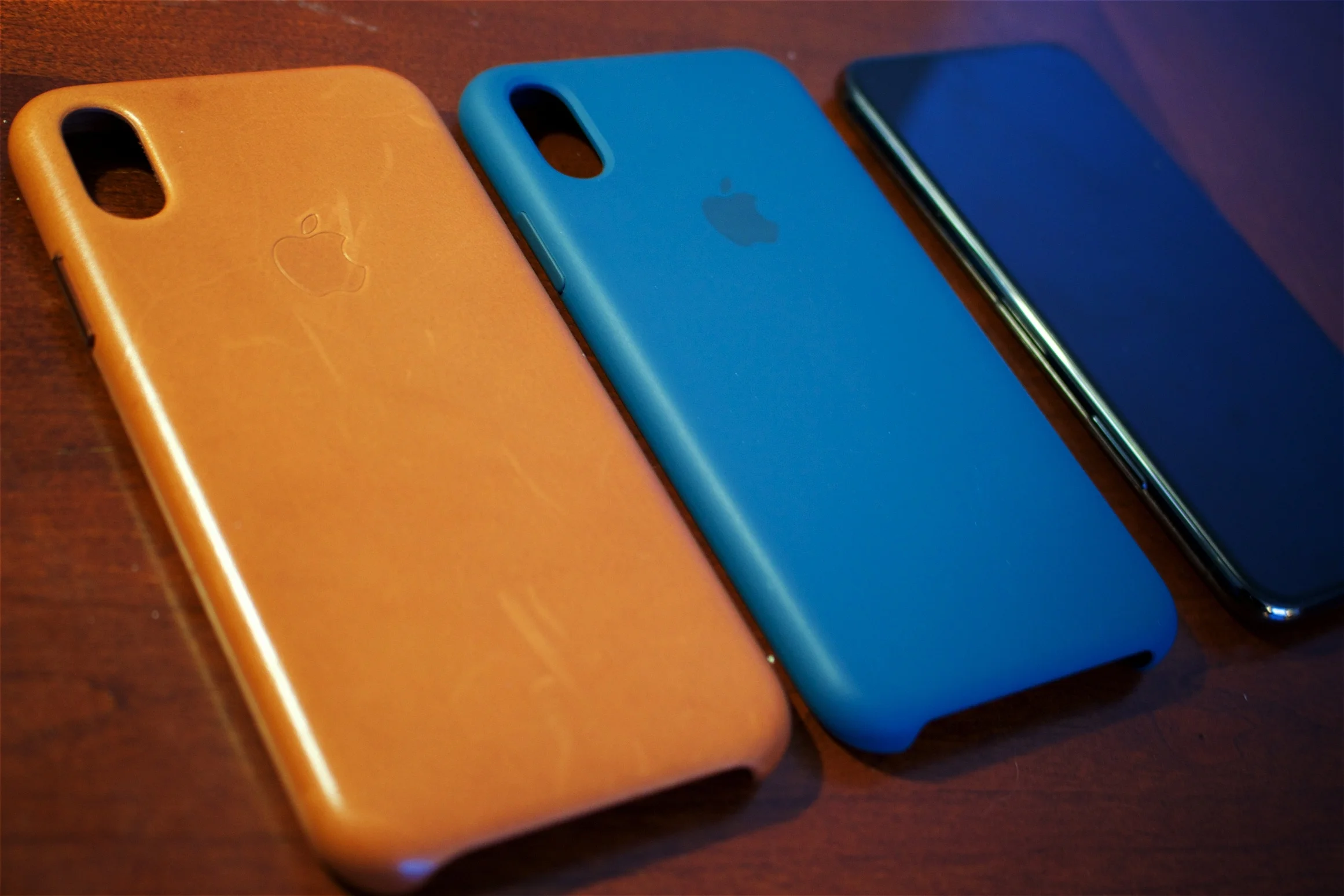
Drop Protection
First, you will not find any drop protection claims anywhere for either of these cases. I can say that I dropped my 6S onto concrete twice with a silicone case without damage. Having both the leather and silicone case, I suspect the silicone one offers better cushioning, just based on the fact that it is soft and the leather case is fairly hard. They seem mainly designed to avoid scuffs and scratches, with a small amount of drop protection.
There are many other heavy-duty cases rated for six or ten-foot drops. I prefer smaller, non-bulky cases with a little bit of padding.
Grip/Feel
The Cosmos Blue silicone case feels slightly powdery and soft. Other than that, it is very grippy.
The Saddle Brown leather case feels very hard and slick. At first it was very slick. After a week it softened slightly, improving its grip.
In terms of touch, I prefer the leather case. Although it is slippery, it just feels great in your hand. Leather also slides out of my pocket easier. Silicone pulls up lint from my pant pocket.
Buttons/Shape/Access
The leather case comes with copper-colored metal power/volume buttons which have a clicky feel. The silicone case has fixed silicone buttons which have a soft feeling.
The access hole for the mute button is smaller on the leather case. It's difficult to fit my thumb into the notch and flick the switch. The silicone case doesn't have this issue.
The bottom of the leather case is more open than than the silicone case. I suspect the silicone case offers slightly more bottom protection. As an aside, I like that the bottom is open, because I constantly swipe up (it's the new home key) and it's nice not to hit the case with my thumb.
The camera cutout on the blue silicone case has a nice chamfer. The leather case does not, although the leather is raised to protect the camera.
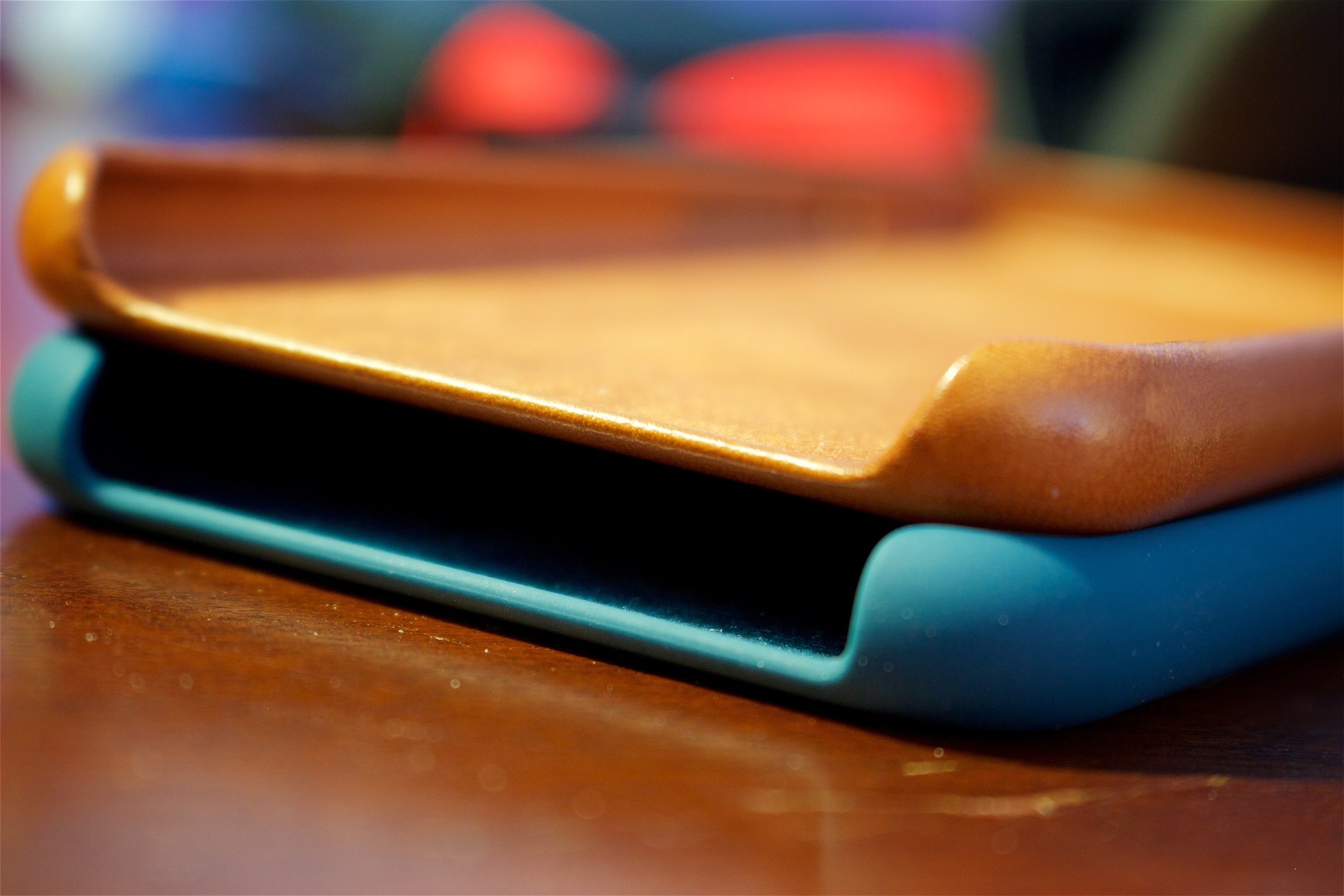
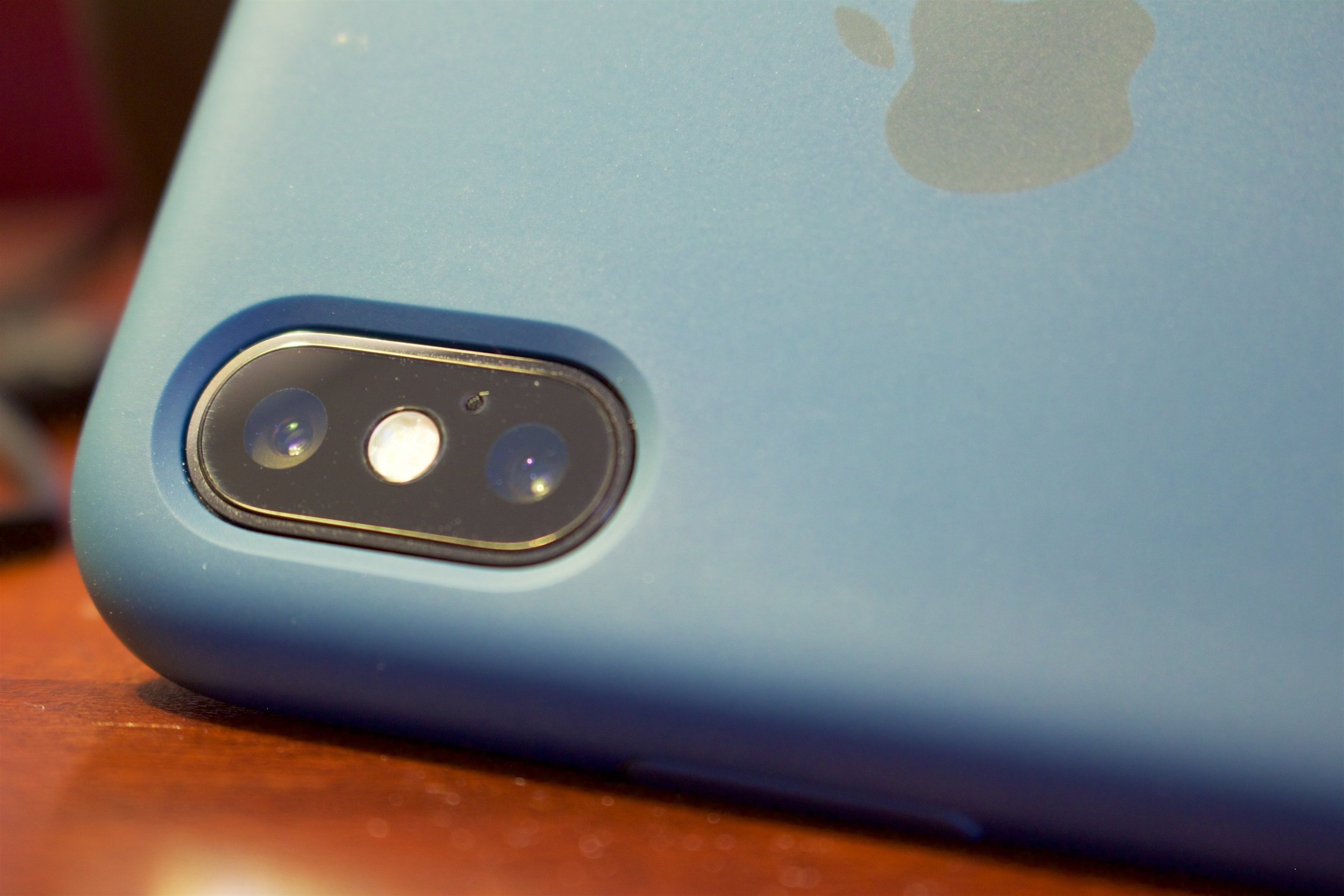
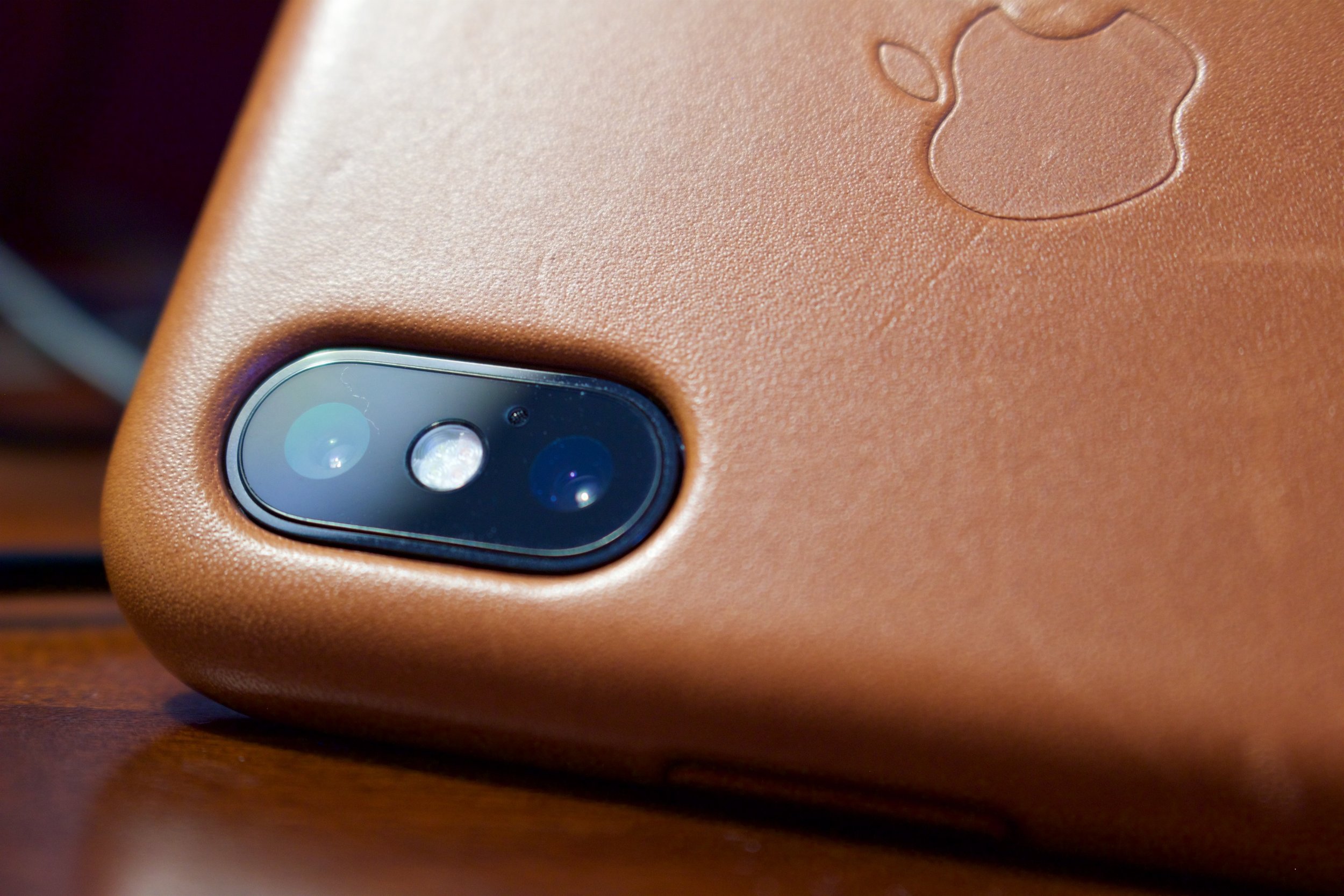
Durability
The silicone case looks the same after time. It's fairly impervious to stains or color change. When it finally wears, it becomes shiny and hard along edges where the underlying plastic is exposed.
The leather case quickly (within a few days) starts to darken. It scratches if you look at it the wrong way. After four days mine had scuffs from fingernails and jean rivets. The case darkens from skin oil, so just touching it will gradually change its color. This isn't necessarily a bad thing for saddle brown, which goes from a caramel color to a leather-bound book appearance. When I set it down on a table at lunch, it picked up a fleck of food with oil, adding a permanent dark spot. Note my experience with other colors of leather cases was different. When I had a blue case, it darkened along all the edges, turning indigo blue. It looked stained, like an old tennis shoe.
Appearance
At two weeks, there is no contest. The leather case looks much more premium than the silicone. I like how the leather is darkening.
Verdict
If I'm going in the field where there's a chance of dropping my phone, I'll put on the silicone case.
For day-to-day use, I'll use the leather case. It looks great and feels nice to hold.


Yes, I bought a $1000 animoji machine
After a week with my iPhone X, I give my random opinions.
I'm a nerd. This should come as no surprise. I bought the first iPhone when it launched in 2007. At first Apple didn't even have an app store - what came with the phone was your only software. There was no front-facing camera and no video capability, It was, however, an awesome mp3 player/internet surfer/phone. And I admit, it was a bit fun when I brought it to work that first time, a crowd of curious co-workers wanting to see the magical gadget.
Ten years later when the iPhone X launched I waffled. It's expensive. It's glass. It swaps out one perfectly fine security feature with another. But that beautiful edge-to-edge OLED screen was compelling, quenching my desire to have an phablet-sized screen in a standard-sized phone. So, last week I reached a tipping point and bought one.
In my mind, I envisioned walking into the AT&T store, saying, "I would like an iPhone X, good sir," handing over my briefcase filled with cash, and watching the clerk slap the box into my eager hand.

The AT&T store's response
Of course, AT&T will not let you buy the phone outright, but instead insists on you signing up for AT&T Next. So, a jillion signatures and forty-minutes later, I finally left with my 64 gb Space Gray iPhone X.
Here's my thoughts after using it for a week:
- First, I love it. Not sure why I waffled so long.

- It's a little taller, wider and heavier than my old 6s. When I hold it with one hand, I hold it differently, resting my pinky underneath the bottom for support. Holding it this way for a while is tiring. It feels much more natural to hold the phone with my left hand while my right does the gestures.
- Those beautiful stainless steel and glass curves simultaneously feel great in your hand and like a wet bar of soap. Sadly, a case is necessary.
- The new gestures are awesome and I do not miss the home button at all. In general, you swipe up instead of clicking the home button, and you swipe up and pause to enter multi-tasking. In multi-tasking you can still fling apps off screen to close them.
- Face ID works so well that I often forget it exists. I'm used to apps prompting me for touch ID when I open them, but now they just unlock without asking for anything.
- The rear camera takes amazing pictures in portrait mode.
- The front camera takes weird pictures in portrait mode. They're fine in regular mode, but the stage/contour lighting produced images which looked like bad Photoshopping.

My first selfie with the iPhone X front portrait camera
- The edge-to-edge screen looks great. You can notice the OLED difference if you set the background to black (in which case, it's pitch black, and icons almost have a 3D effect). In terms of color and clarity, though, it doesn't look much different than a regular iPhone.
- In portrait mode, I ignore the notch. In landscape mode, the notch is a little weird, but not a big deal.
- Although I'm not sure if I'll use animoji, every single person I showed them to was entranced and played with them, laughing.
A few quirks:
- When reading a webpage, it's typical to scroll up with your thumb and pause while you read new content. But this is the same gesture to launch multi-tasking.
- The power-button-that's-sometimes-the-power button is odd. It's now a multi-function button that does everything from opening Siri to using Apple Pay. You can turn the phone on with it, but turning the phone off requires pressing it and the volume button.
- At work, I lay my phone flat beside my computer. To trigger face ID, I need to lean into the phone a bit. By default, all notifications on the lock screen are masked (they just show the app and something like "new message") until the phone sees you. It's kind of cool that it's a "for your eyes only" feature, but I turned it off because I got tired of constantly leaning in to see my emails.
- Although the phone displays a remaining battery graphic, the battery percentage is hidden in the control center. I miss the battery percentage.
- Surprisingly, the phone comes with wired headphones which have a lightning connector, but the headphones no longer include the plastic storage case.
But, overall it's a great phone, and I'm glad I upgraded from my 6S to it.


Books Butterfly Promo Results
My first promotion with Books Butterfly is nearly complete. Here are my results..
Last month I set 43 Seconds perma-free on Amazon. Like many indie authors, I followed the strategy of offering the first-in-series as free to attract new series readers. Since doing that, I've received a trickle of daily downloads for 43 Seconds.

I've read about Books Butterfly guaranteed promos, which guarantee a specific number of downloads, and decided to give them a try. Overall, I'm happy with the results. Here's how it played out:
1/23/18 - I requested the Silver Eagle promotion package ($50) with a guaranteed 500 book download via Books Butterfly online signup form. The site had a Stripe popup which had me pay $50 at the time of signup via credit card. On the form, I could enter my requested ad date. I just entered 'first available' since my book is permafree, and I indicated the book is permafree. I received a confirmation mail the same day from Book Butterfly stating my request was received and someone would get back to me within a few days.
1/26/18 - I noticed a spike in downloads for 43 Seconds. I hadn't heard anything yet from Books Butterfly, but assumed they must have started running the ad.
1/27/18 - I received a confirmation email from Books Butterfly that my ad started running on 1/26 and would continue until 2/6 on Kindle, Nook, Apple, and Kobo. There were many terms and disclaimers in the email including a one-time exception to guarantee downloads for a short story. Books Butterfly offers a prorated refund in the event they don't meet the minimum download promise (the refund is in store credit).
Here's the results of the promo (as of 2/6 @ 6 pm)
Downloads: 473 (Kindle 415 / Apple 49, Nook 9, Kobo 0)
Paid Sales (other titles): 7
New Reviews/Rating during the ad period: 4 (Kindle 2 / Apple 0 Nook 0, Kobo 0, Goodreads 2)
In general, downloads per day were ~60 at the start of the promo and ~30 the second week. Note this download rate was sufficient to keep 43 Seconds in the top ten free books for its category, which was helpful. Its best spot was #4 on the Sci-fi & Fantasy 90 Minute Kindle Short Reads list.
Overall, a good result. I've easily spent $20 on Amazon promos which yielded a single 99 cent sale, so $50 for 500 downloads and 7 sales is a good value. The ad did not pay for itself in terms of sales, but I sell 99 cent short stories and no ad has ever paid for itself (I need to sell higher-priced books before ads become viable). For now, the ads are about building a customer base for the series.
I should note that book totals for the guaranteed download promise should be calculated through 2/7, so I don't have the final tally today as of 2/6. 473 is close to 500, and it's entirely possible I will pass 500 downloads by the end of 2/7. Either way, I'm happy with the promo result.
Lastly, if you were one of the readers who left a review or rating - thank you! You can see that out of the 415 Kindle downloads, 2 left reviews, so this is 0.5%. You are in the top half-of-one percent and you're awesome - thanks again!
EDIT: The final download total (Kindle, Apple, B&N, Kobo) at the end of 2/7 was 506
If you enjoy sci-fi stories about pilots, why not get your free copy of my short story, 43 Seconds, on Amazon Kindle? It’s part of the Hayden’s World series, which is about a pilot willing to risk everything for a shot at the stars.

Some Completely Unnecessary Math
The title says it all. This is what happens when I have a day off.
When I read Andy Weir's The Martian, I realized there was a whole genre of science fiction that took the science part seriously. It's interesting that the original genre of science fiction was just that - fiction extrapolated from science. Sure, I know there's a hard science fiction genre, but Weir started at Bill-Nye-Science-Guy-level and turned it up to eleven.
Even if you're not a hard science fiction fan, there's the puzzle appeal. You'll find it in movies like Apollo 13. Everyone remembers the square-peg-in-a-round-hole brainstorming scene. Or MacGyver, a fellow who literally saved himself and everyone else each episode with science.
Now that it's Christmas, it makes me think of the meme where someone calculates how fast Santa's sleigh would need to go to traverse the world overnight, and what would happen if it did. There's some nerdiness in us all.
I'd read that Weir actually calculated the orbital mechanics of the Hermes in the Martian. I remember thinking he could have just said the NASA guys worked it out in the story and I would've taken his word for it, but, at the same time, it's the sort of thing I do in my stories. If it takes twenty-six days for the Aristarchus to get from the outer system to Earth, I've actually done the math. At times it's been my bane. Simple things like flying from Saturn to Cassini Station (just outside Saturn's rings) in Erebus takes hours of flight time. Space is big. Saturn is really big.
Recently I was watching one of my favorite sci-fi movies of all time, Star Trek II: The Wrath of Khan. I can't say how many times I've seen it. At the end there's the dramatic escape when Khan activates the Genesis device and Kirk says, "Scotty, I need warp speed in three minutes or we're all dead!". Mid-scene we hear that the Enterprise's distance to the Reliant is 4000 km. Sulu says, "We're not going to make it, are we?". David shakes his head. Great stuff.
So, here's where the nerd in me perks up. I know the Enterprise has been shot up and is operating under impulse engines or thrusters. However, it's always struck me that 4000 km is not very far for a starship. If you pay attention, Kirk provides a time and distance in the clip:
Kirk: "Time?"
Saavik: "Three minutes, thirty seconds."
Kirk: "Distance from Reliant?"
Chekov: "Four thousand kilometers."
I'm going to make an assumption the Enterprise was accelerating that entire time. Which would make sense if they're using thrusters. I have no idea how Star Trek's impulse drive works, but if it's a space-bending-continuous-speed thingy, then the math is just distance over time:
4000 km / 3 minutes 30 seconds = 19 kilometers per second
This is fast, but slower than most asteroids. As an aside, not even Star Trek seems to know how its impulse drive works. In some movies they use impulse drive while in space dock, which, you know, seems like a bad idea.
Now if the Enterprise is accelerating at a constant rate from a standstill, the math is a little harder:
distance = 1/2 acceleration * time (squared)
If you solve for acceleration, the Enterprise is accelerating at 18 g
Presumably Star Trek's inertial dampeners keep everyone from getting squished. On the plus side, this is faster than I thought. 18 g acceleration will get you from Earth to the Sun in a speedy 16 hours. Unfortunately the (albeit damaged) impulse drive doesn't work out so well in the long run in this case. Traveling a continuous 19 kps will take 91 days to get from Earth to the Sun. So, stick with the thrusters.
Anyway, this is what happens when I have a day off. Enjoy the geekiness.
Pulp Fiction
Serial fiction is an itch I needed to scratch with my keyboard.
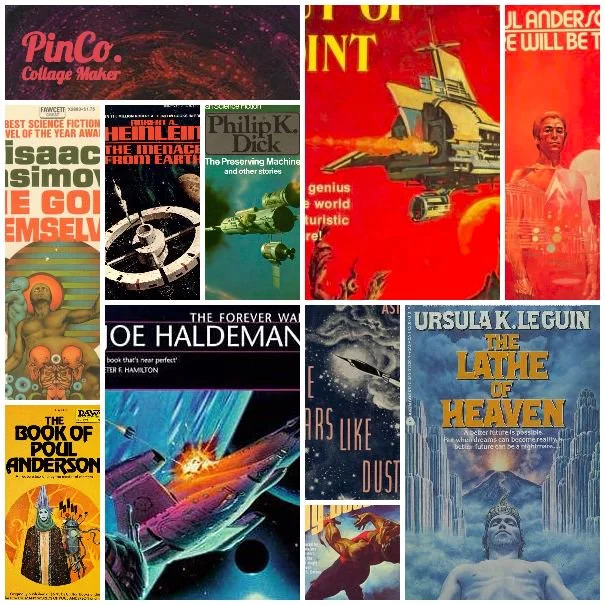
If you've read 43 Seconds or Erebus, you'll know James has nostalgia for the golden days. His dreams are an extension of my own. Instead of the golden days of aviation, however, I dream about the pulpy days of science fiction. Book covers painted in gauche with paint-streaked rocket ships bisecting star fields, like these:

Like 'em? Check out my collection on Pinterest.
I also love the concept of the serial, tuning in next week or getting the next issue to see what befalls our hero. It's really the structure for most modern sci-fi television, whether you're watching Dr. Who or Star Trek. Bite-sized stories consumed sequentially, starring the same characters, focusing sometimes on the star, sometimes on the co-stars.
When I conceived Hayden's World, it was a full-fledged book. I thought the voyage to get to that point, however, was its own exciting story. I'd been searching for Kindle short reads to consume each night in bed - ninety-nine cent stories I could read in under an hour. To my surprise, there was a shortage of them. It was an itch which needed to be scratched, and I decided to tackle it with my keyboard.
Publishing sci-fi shorts on Kindle is surprisingly difficult. I think people are more likely to try a novel from an unknown author than a short story. It's nearly impossible to advertise ninety-nine cent fiction without losing money. I've found the most effective paid promotion is simply to buy the books from Amazon and give them away (via Amazon's Giveaway program). Kindle Select allows me to set the price to free for up to five days every three months. and this moves two hundred copies if I pay for basic advertising. Recently I had a friend ask if there was good money in my Kindle sales. I told him I could buy one nice dinner-for-two yearly from them.
This quote from author Palessa on Nicolas C. Rossis blog sums it up perfectly:
On the author side, I decided to go more for brand awareness than book sales, because if I’ve learned anything in this whole independent author journey, it’s that obscurity is the force we are all fighting against.
The main challenge hasn't been one star reviews. It's publishing to the abyss. It takes money and effort to keep your needle in the haystack from sifting to the bottom of the pile. And, you've got company there. You can deduce this fairly quickly from your Kindle stats. When your book bottoms out in sales, it moves to a sales rank of around three million (meaning, there are three million books in the pool, and you are at the bottom). When you sell just one copy, your rank jumps to one hundred thousand. This means those 2.9 million other souls are selling no copies.
I'll admit, it's daunting. I was an artist before I was a writer. Both are creative endeavors. Art is easier, though. It's visual. When you post a newly completed piece online, you immediately get feedback. People can assess its merit in the few seconds it takes to glance at it, and respond. They can share the image socially. Writing, though, is different. There's a commitment to read a story, and then it takes more than a Facebook like to give feedback.
I'm four stories deep now in the Hayden's World series and excited about the subplots developing. There's plenty to explore, especially with James's discovery in Erebus, or the lack of closure with the pirates in Aero One. Looking forward to seeing what happens next with our heroes.
As always, you can help with your feedback. Leaving a rating on Amazon or Goodreads really helps, or just a comment on this blog if you like a story or have questions about what's next. I love to hear from readers, so drop me a line.
Thanks!

If it's free it's for me
Get 43 Seconds for free from your favorite retailer: https://www.books2read.com/43seconds
43 Seconds is FREE on most major vendor's sites. You can get it on Apple iBooks, Barnes & Noble, Kobo, Scribd, and several others. On Amazon Kindle it's still 99 cents, but hopefully Amazon will price match it in the near future. Click here to get your copy: https://www.books2read.com/43seconds

Grammar Police
An engineer slowly learns the rules of grammar.
I admit, the math section of the SATs was easier for me than the reading section, which is probably why I became an engineer. Despite that, I still really enjoy Weird Al's Word Crimes:
In keeping in theme with my recent post discussing what I've learned in my first year of self-publishing, I thought I'd mention a few grammar confusions I needed to work through:
Since
Apparently I've been using the word "since" incorrectly my entire life. Case in point:
Since I'm here, I may as well have some french fries.
I should be using it like Kelly Clarkson:
Since you been gone, I can breathe for the first time.
Granted, "since you been gone" isn't the best grammatical example, but hey.
"Since" references a period of time. I've been waiting here since nine o'clock. Or, Since learning that I use "since" incorrectly, I need to sing that Kelly Clarkson song to remember how to use it.
Which/That
Aaargh. Quick quiz - which is correct:
Cut the wire which is red
Cut the wire that is red
There's a better explanation detailing restrictive clauses, but I find it's easiest to replace the word "which" with "which happens to be". If the sentence still makes sense and has the same meaning, you're good.
Cut the wire, which happens to be red. It doesn't really matter that it's red. Just pointing that out for people who like the color red. Pretty!
Cut the wire that is red. There's also a black wire. Please don't cut the black...oh my God, you're not even listening to me! Give me those wire cutters!
Feeling Possessive
Sure, it's been several hundred years since I went to elementary school and my memory may be a little foggy, but I distinctly remember the rule to use an apostrophe s unless the word already ended in s, in which case just use an apostrophe. Granted, that was back in Arthurian days when we spelled town with an e.
It seems I'm supposed to use an apostrophe s for singular nouns (regardless of their ending letter) and apostrophe for plural nouns that end in s. Actually, if you Google it you'll find the Internet's definitive opinion on the matter is:
- Apostrophe s for singular nouns; apostrophe for plurals ending in s
- Apostrophe s for nouns that don't end in s; apostrophe for words that do
- Apostrophe s if you speak the s; apostrophe if you don't
- These can't all be true, but it doesn't matter, just be consistent
- Why do we even have language at all. Let's just grunt and point.
- Hey, there's a new Cinemasins videos. Wait, what was I Googling again?
Anyway, in my stories you'll see:
James's
and not
James'
That is, unless a Riggs malfunction creates an army of duplicate James, and they all collectively own something.
As an aside, why English has chosen the possessive form of "it" to be "its" is mind boggling. More accurately, it's mind boggling. I realize that "it's" has been claimed as the contraction for "it is", but there's no reason you can't contract "to be" onto any noun, as in "Hey, Bob, cat's gone missing again" or "That grammar rule's silly."
Okay, that's enough pearls for today. Back to writing.

What I've Learned in One Year of Self-Publishing
June 12th, 2016, I uploaded 43 Seconds to Kindle Direct Publishing and clicked the submit button. One hour later it was live. Since then, I've published Signal Loss, Aero One, Hayden's World Shorts, and Erebus. When I started, I recall reading many self-publisher's blog posts about how their journey unfurled. I thought I'd share mine after the first year.
June 12th, 2016, I uploaded 43 Seconds to Kindle Direct Publishing and clicked the submit button. One hour later it was live. Since then, I've published Signal Loss, Aero One, Hayden's World Shorts, and Erebus. When I started, I recall reading many self-publisher's blog posts about how their journey unfurled. I thought I'd share mine after the first year.
Writing Craft
There are endless books on story structure, plot, characters, grammar, and dialogue. I devoured them. James Scott Bell's and Marcy Kennedy's series are very helpful. By far, Self Editing for Fiction Writers is essential and probably should be required reading for self-publishers. It addresses many of the common problems newer writers face.
Here’s a few things I've needed to focus on as a newer writer:
Passive Voice (the bane of newer writers):
Long ago I wrote a story titled "Wraith's Dance" and submitted it to Weird Tales. I received a refusal letter, but was pleasantly surprised that it included a constructive critique from the editor. He liked the story, but the deal breaker was its passive voice. Keep writing, he encouraged.
When we speak, we're used to telling a story using the word "was" to indicate a transient action:
He was running down the hall when the bell rang.
Ditching the word 'was' and just using the actual verbs ran or rang changes the sentence from a state (was running) to an active verb (he ran, the bell rang):
He ran down the hall as the bell rang.
The bell rang as he ran down the hall.
Both are more engaging than "he was running down the hall".
I recommend using your word processor's Find/Replace to locate every use of "was" and determine if it's needed. I found this was littered throughout my writing.
A little less common, but even worse, is using was to put the recipient of the action first:
The martini was splashed in his face by Jane.
Much better to write:
Jane splashed the martini in his face.
I can't recall which writing book listed the acronym R.U.E, but it definitely applied to my early work. R.U.E. is "resist the urge to explain". The biggest offender for me was "to", as in:
He opened the door to search for the axe murderer.
Better to let the reader figure it out based on the character's actions:
His pulse raced as he reached for the door knob. He had to find Eugene before he killed again.
Seriously, it was everywhere in my writing. To do this, to do that. Readers like watching a character and trying to deduce what they're up to.
Tight Writing and Pacing
As you'd guess, don't use a hundred words to say something best described with a dozen. I found my biggest offender was the word "of":
Pools of radiant light filled the room.
Flowery, but better to say:
Radiant pools filled the room.
Right? Radiant is a stronger word to start the sentence and doesn't require mental gymnastics to extract the modifier between the object and verb.
Pacing's a little harder to pin down. It's easy when writing sci-fi to get swept away in descriptions, but endless description is boring and endless action is tiresome. You need to constantly mix-up description, actions and dialogue to keep things moving. The other thing I'll say is that it's often better to suggest descriptions with a few well-chosen words. For instance, the waves bled with fading sunlight conjures a complete mental image in six words.
When I wrote Aero One, the opening paragraphs were very focused on Jia's senses and confusion. The high level or detail didn't match the urgency of her situation, though. I self-edited it down to:
Thoughts spark and fizzle in an overlapping jumble of competing primal urges. Air. She needs air.
Head Hopping
Phew! This one's tough. We've grown up watching television and movies which constantly cut between different character's perspectives. Some are better than others at keeping you in the main character's head.
For example, the camera frames a close-up of Bob's expression as he looks down at a letter. Next, it cuts to what Bob reads in the letter. Off-screen, we hear the clinking glasses as Sandy opens the kitchen's liquor cabinet. Great!
More typically we see Bob reading a letter followed by a camera cut to Sandy in the kitchen. Bob can't see Sandy from where he's standing in the study, but we get to see her pouring the poison into his brandy.
When I started writing I mimicked this cinematic approach. There's no rule that says you can't do that, just keep in mind that in this case you're writing as a detached omniscient viewer and your reader will have the same experience. This weighed on my mind as I wrote my recent story Erebus. Staying with Sarah's perspective meant the reader didn't know what happened to James. If this were a tv episode, it would have cut simply to what James was doing while Sarah searched for him.
Note this doesn't mean that you can't change character point-of-views using line or chapter breaks. Just keep in mind there are pros and cons to POV changes.
Dialogue
The simplest rule is "he said/she said".
"Yup, we're all going to die," Hitoshi said.
I remember getting confused and sometimes typing it backwards:
"Yup, we're all going to die," said Hitoshi.
But that puts the verb before the object.
Even better, eliminate the dialogue tag with stage direction:
Hitoshi facepalmed and shook his head. "Yup, we're all going to die."
Formatting Your Book/Creating Cover Art
Scrivener is invaluable for organizing and writing your story. It's project management software for writers.

Scrivener project file for Erebus
If you have enough patience, you can produce well-formatted books directly out of Scrivener. I did not, so I purchased Vellum. Vellum's expensive, but produces beautiful books.

Vellum file for Erebus. Very easy to create a professional ebook or paperback.
Canva is the easiest way to create a quick book cover online, and it's cheap. Alternatively, if you have some design skills you can purchase stock photos (make sure you select the right license) and assemble your own cover in Photoshop.

Paperback cover design in Photoshop for Hayden's World Shorts. Background planet is a licensed Adobe stock photo.
If you have artistic skills, you can use Adobe Illustrator or Photoshop to create custom artwork. For Aero One, I designed the cover from scratch. The nice thing about doing all of the artwork yourself is that there is no licensing:

Pro tip when doing your own design in Illustrator: also design social media graphics, like the cluster on the left of Facebook and Twitter cards designed for ads and free promotions.
Lastly, you can also outsource it to a designer via a site like 99 designs.
Here's how I created the cover for 43 Seconds:
- The background's warp effect is a licensed Adobe stock photo
- The spaceship is a 3D model created in the free modeling software, Blender
- The foreground text is a layer in Photoshop.
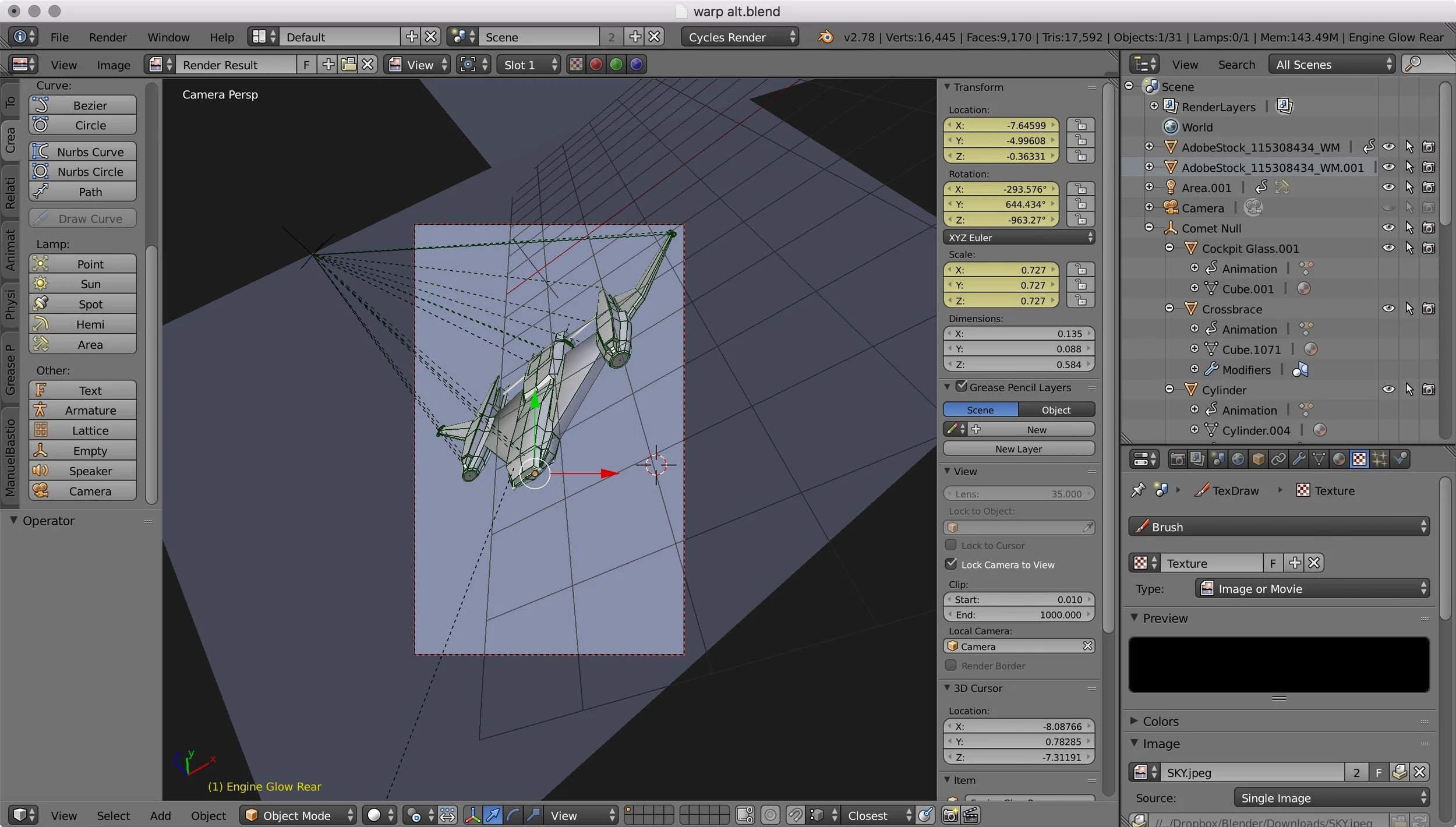
Blender 3d model of Bernard's Beauty for 43 Seconds

Photoshop composite of background art (generated in Blender) with foreground text
Reviews and Sales
And now the bad news. When I started I feared I would post my book and get peppered with one-star reviews. The reality is that next-to-no-one will see your book, and out of those that do, one-in-a-thousand will leave a review. Getting peppered with negative reviews is an upgrade to where you actually start. I've had my best luck getting reviews with Amazon Giveaways. I do use KDP free days, but they never generate reviews.
Regarding sales, my annual book sales can probably buy me a single, nice dinner. If you're looking to make money, I suggest trying to sell to magazines. If you get 6 cents per word for a 6000 word story like 43 Seconds, you'll make $360. Maybe I'll try writing some non-Hayden's World stories and submit those to magazines.
Advertising
Amazon ads do work, but they are not cost effective for 99 cent books (unless you can upsell a series). I typically land in the 40 to 50 cents-per-click range and need ten clicks to get one sale. Four to five dollars to sell a 99 cent book isn't a sound business model. Giveaways work better because four to five dollars gets you four to five sales. Without ads or giveaways, however, my books fall into obscurity. When using ads, Product Ads work much better than Keyword Ads in generating actual sales, probably because they are better targeted.

In the top chart, the blue bars represent free books purchased and the orange bars are paid books sold. The bottom chart shows pages read via Kindle Unlimited book borrows. In December 2016, I learned how to promote my Kindle free days more effectively and started using Amazon ads.
Spamming buy-my-book on twitter is counter-productive and will cost you followers. Twitter is for sharing content. I do recommend posting snippets of your good writing, especially if they fit the day's theme (SciFiFri for example), or if they're works-in-progress and fit the #amwriting tag.
Wrap-up
I feel like I've learned a lot this first year. I've taught myself Scrivener, Photoshop, Illustrator, Blender, Vellum, and KDP. Getting an occasional review from an excited reader makes my day. Writing in series for the Hayden's World stories has been challenging because each story needs to be independent, and each time I finish a work I have this self-doubt phase of wondering how I'll come up with something new. But, the stories keep churning out, and they're getting longer and more complex:
- 43 Seconds - 6000 words
- Signal Loss - 9000 words
- Aero One - 9300 words
- Erebus - 17,000 words
So, marching into year two and seeing where my keyboard takes me.

Erebus - Writing and Story Tidbits
A few writer's ramblings about where my ideas came from and how I tackled Erebus.
SPOILERS ALERT! If you haven't read Erebus, grab a copy first. It's only 99 cents. Seriously, you can't even get someone to read a 17,000 word story to you for 99 cents.
Erebus is the inverse of my original story idea. In my first draft, Sarah was the one who got trapped in interstellar space and James rescued her in Bernard's Beauty. I still have the draft of chapter one, titled "Gamma 222". Here's a clip:
Sarah breathes fast, her words muffled by the mask. “Collapse the wave.” She spins the damage control graphic with his fingers. Red flagged systems follow a diagonal line bisecting Gossamer Goose. Ballistics calculations plot the trajectory of the impactor.
But I really didn't want Sarah to be a damsel-in-distress. So, I flipped it.
One of the issues I immediately ran into is "one too many heroes" and I needed to think a bit about using story structure to address this. One thought was to use parallel stories, like "The Martian", with some chapters following Watney while others followed the NASA rescue efforts. You can see how James's scenes - crashing Bernard's, scouting the snowy landscape - would be compelling as their own chapters, and toggling between his and Sarah's story would be interesting. But, ultimately the story is Sarah's. It's about her voyage there, what she's feeling, how it changes her, and what she does when she gets back. As interesting as James's adventures are, they're the background events. It's a bit like how the movie Titanic wasn't really about the Titanic.
As an aside, I notice that James, who was the clear hero in 43 Seconds, takes the role of catalyst in the subsequent stories. When I write him, it's very easy for him to overshadow the lead characters, so I always need to use some restraint. I also like how his strength (taking risks) is also his weakness.
Handling time was one of the consistent narrative challenges. During James's voyage to Erebus, he and Sarah are in different timeframes. I decided to give a sentence or two for each of them during Jame's six transmissions. It's similar to the approach I used with Jia's video journal in Aero One. William's slightly convoluted whiteboard diagram for the rescue was another visual tool to help with time. Pepper in some flashbacks via James's two video logs and you've got a narrative moving on multiple time axis.
In a way, this story was a bit of an all-star reunion for many characters. A few thoughts:
- I'll bet James and Will's offices are just like you imagined. Letting Sarah sit in both gave a chance to see what each man valued.
- My beta reader commented that she always liked any scene where Hitoshi appeared. In 43 Seconds, he was Q to James's Bond. In Erebus, he's a little like Galaxy Quest's Guy, having read far too much sci-fi to think it's a good idea to be on an away team. I relate with him the most.
- Ananke could've used more air time, but she does get to ask a very important question near the story's end.
- I broke a bit of a story rule by introducing two new characters midway through the narrative. Isaac gets a decent share of talk time, but you don't get to learn too much about his or Julian's personality. I'm sure they'll appear in future stories. On the plus side, it was fun having an actual crew, and I liked how they each had their own area of expertise for the mission.
And a couple of plot tidbits:
- Cassini Station was developed for a new story called Titan's Shadow. It seems like a fascinating place, and I'm looking forward to exploring it. Here's a clip:
Rolin shrugs.
“Why didn’t facial recognition pick him up?”
“Cassini Station doesn’t have an open security agreement with EarthSec.”
“Well, that’s idiotic.”
He gestures towards the shops. “Everyone who comes here has some reason to get away from Earth.” He appraises Jia a second. “If Cassini had an open sec agreement, probably a quarter of its shops would be gone.”
- James tucking himself weightless into a wall-mounted sleeping bag was inspired by Chris Hadfield's video of sleeping on the International Space Station.
- When I wrote 43 Seconds, it occurred to me that if a ship could maintain greater than one gee acceleration for days at a time, then it could maintain a one gee deceleration long enough to land on a planet. The reason real-life spaceships can't do this is because they are rockets and are bound by the rocket equation. This means they can't possibly take enough fuel with them to both accelerate and decelerate the full way (because the fuel has mass and needs to be accelerated itself, requiring even more fuel). So, real spaceships need to fall from the sky at orbital speeds.
- At the end of the story Riggs switches from a threat to a defense. In the 1960s, fear that Russia would develop space superiority and deploy orbital weapons fueled the Apollo program.
- The idea of a ninth planet (or tenth, prior to Pluto's demotion), has been around for a while. Dubbed Nemesis, some thought it was a distant object perturbing the Oort Cloud, raining comets down upon us. More recently, the theoretical planet was given a working name of Xena based on the Xena Warrior Princess tv series. When it is discovered, it will be given an official name. This will be challenging because the majority of roman and greek gods have already been assigned to dwarf planets, asteroids, or moons.
- As an aside, there was an actual distant orbit which grazed the Oort Cloud not very long ago (from a cosmological perspective). Scholtz's Star passed through our Oort Cloud 70,000 years ago. It kept on going, and is now 17-23 light years away. When it passed through, it was 52,000 AU away. In Erebus, Gossamer Goose travels 1200 AU. Scholtz's Star may have perturbed comets, but it will be two million years before any make it to Earth. When Scholtz's Star passed by, it would have been magnitude 11.4. The Neanderthals and early humans alive at this time lacked the telescopes to see such a faint object.
- In mythology, Erebus was the primordial god of darkness and consort of Nyx (Night). Janus is the god of beginnings, gates, transitions, time, duality, doorways, passages, and endings. You can see why I chose Janus for Sarah and James's adventure.

Erebus (First Chapter, 1200 words)
Sarah pushes the Pintail’s flight stick forward and the aquamarine sky rolls away. Below, the cloud deck is an impossible swirl of cinnamon and gold with pockets of flickering lightning. Thunder rumbles in bursts, its audio out of sync with the light show. Through the cockpit windows great banded rings fade into the horizon and the scale of it is almost too much to take in at once. Motion catches her eye as a silver glimmer carves a vapor trail across the sky. It changes course, the vapor trail bending, then corkscrews a white spiral before matching her altitude. Saturn’s moons are an audience of bright stars behind it.
“Well, now you’re just showing off,” Sarah says to her helmet mic.
One
Arizona Sunrise
Sarah pushes the Pintail’s flight stick forward and the aquamarine sky rolls away. Below, the cloud deck is an impossible swirl of cinnamon and gold with pockets of flickering lightning. Thunder rumbles in bursts, its audio out of sync with the light show. Through the cockpit windows great banded rings fade into the horizon and the scale of it is almost too much to take in at once. Motion catches her eye as a silver glimmer carves a vapor trail across the sky. It changes course, the vapor trail bending, then corkscrews a white spiral before matching her altitude. Saturn’s moons are an audience of bright stars behind it.
“Well, now you’re just showing off,” Sarah says to her helmet mic.
Her heads-up-display brackets the other ship as James speaks over comms. “Just stretching my legs. Besides, I’ll bet you can do better.”
“Oh,” she says, drawing out the word, “all right then, game on. Keep up, if you can.”
Sarah breaks hard to the left and the sky rotates ninety-degrees. She’s diving, picking up speed, watching the giant cumulonimbus cloud grow nearer and nearer until it blots out the small disk of the sun, then she pierces it and a dark fog envelops her with the jolt of thermal turbulence. All of the cockpit lights dim and change to amber, their illumination casting colorful patches. She glances at the three-dimensional plot of cloud schematics and wind vectors showing James’s relative position. A push of the stick and she’s diving again, down through the base of the cloud with distant lightning flashes momentarily breaking up the fog, then she bursts through the bottom and pulls up to level out. The Pintail throttles back and Sarah takes a moment to breathe and just watch the sights. Overhead, the cloud stack is a roof the size of the Grand Canyon, flattened, stretching off into an infinite dappled orange ceiling. Sunlight shafts create drifting havens in the twilight.
James emerges from the cloud bottom and accelerates to her starboard. His Pintail is white with silver wings adorned by the two-tone Hayden-Pratt logo. Its strobes paint her cabin like a blinking neon sign outside a city window.
“Well that was fun,” James says. Sarah can see him in his cockpit, his helmet turned toward her. He lifts a gloved hand and gives a thumbs up.
She smiles. A thumbs up from James means something to her, and, for just a moment, she can’t believe that she’s really here, flying one of the first two production Pintails over Saturn’s ammonia clouds, looking over her shoulder and seeing the only person to fly near light speed tucked into her wingman position. “Hey,” she says, “what’d you think of the view?”
“It’s like an Arizona sunrise,” James says. “Smile, I’ll take your picture.”
Sarah gives a thumbs up as he snags the image from his wing cam.
* * *
Cassini Station is an azure jewel dangling from the golden necklace of Saturn’s F Ring. Strobes blink from space traffic gliding in and out of the station. It’s a work-in-progress, great swathes of framework exposed to vacuum, modules partially in place, and a building-block-like matrix of alloyed plates hinting at the future bends and curves of the structure. Sky blue interior lighting transmits through the habitat’s translucent domes, and, even from this distance, Sarah can see movement. People. In front of it all, taupe-and-twine-hued rings span back towards her.
Sarah lands her Pintail at Cassini’s lower dock, gets cleaned up and changes out of her flight gear. A shuttle connects her with the commercial decks. Microgravity appears when she enters the station’s rotation, growing in strength until she’s under a full gee. When the shuttle door opens, she steps into Cassini’s shop-filled Promenade.
James sits at their favorite table in front of the Panorama. Saturn emerges behind him like a full moon rising, sideways, its rings bisecting the view top to bottom. Smoothly it glides up with stars trailing in its wake. Two glasses of amber beer wait on the table.
“Hey,” Sarah says, sitting. She motions to the beer. “You know they brew that stuff from Titan’s lakes, turn the ethane into ethanol.”
James smiles. “Sippin’ the universe. You want something else?”
She grabs the glass, lifts it, and clinks it against his. “Here’s mud in your eye.”
It’s cool and bubbly, tasting like a mixture of wheat beer and rubbing alcohol. Sarah grimaces and scrunches her eyebrows, forcing herself to swallow.
James laughs and wipes his lips with the back of his hand. “Holy hell.” He coughs and slides the beer away.
She smacks her lips. “I know I was one-upping you back there a bit, but I didn’t think you’d try and kill me.”
“We should bring back a liter for Will.”
Sarah points. “Now that’s an idea.”
James chuckles and glances at the slate. Her eyes follow. “There’s something I want to show you,” he says, pushing the slate over.
Sarah leans in. A standard engineering schematic glows blue on the slate. The top view outlines a flattened wedge-shaped ship, an arrow of cockpit windows at its front. Sixty-two meters nose-to-nail. She’s never seen this configuration before.
“What’s this?” Sarah asks, engrossed.
James waits and smiles.
She pinches and zooms the screen. Her mouth opens. “Three terawatt reactor! Damn, James, what’re you going to do with that?” And then she sees it, the halo of emitters configured in a sphere of interlocking rings tucked behind the reactor. Riggs wave generators. This ship has a Riggs drive.
James reads her expression and says, “The best Bernard’s Beauty will ever do is ninety-eight percent light speed, but this…” He points to the blue print. “This will reach ninety-nine point nine. Full hab deck, max crew of six, enough fuel for three months.”
“Woah.” She does some quick math in her head. “So, her range will be almost three light-months? You could get to the Oort Cloud.”
“Ah, see, I did the same thing on my first Bernard’s flight. Three months ship’s time is sixty-six actual months. At ninety-nine cee, that’s five-and-a-half light-years.”
She processes that a moment, searching his eyes. “You can get to Proxima Centauri. Hell, the entire Centauri system.” Now she’s excited, indexing star charts from memory. “You could almost reach Barnard’s Star.”
“Yup, but it’d be one way. Realistic range for there-and-back is half that.”
“That’s incredible! Are you going to build it?”
James nods. “MEO2 shipyard is setting up as we speak. Construction starts end of this month.”
Her eyebrows raise and she laughs, nearly a giggle. She feels like a kid who’s gotten a sneak peek at the world’s coolest toy. Her fingers brush over the screen. Without looking up, she asks, “What are you going to call it?”
James turns up an open palm. “That’s up to you.”
Sarah meets his eyes. “Really?”
“She’s yours, Sarah,” he says, leaning in. Butterflies cascade through her stomach. “You’re the best pilot I have. I want you to fly her.”
* * * *